Accessible only at low tide via a boggy and occasionally scrambly walk, MacKinnon’s Cave looks fairly unassuming until you realise just how enormous it is. It stretches roughly 500 feet into the cliffs and is the largest cave in the Hebrides. You will want a head torch. Ideally two. One for confidence and one for when you inevitably question your life choices halfway in.
It was famously visited by Samuel Johnson and James Boswell during their journey through the Hebrides, later written up in A Journey to the Western Islands of Scotland. Their accounts helped shine a light on places like Mull at a time when most of it was still properly off the radar for travellers. But long before any literary tourists turned up, the cave already had stories attached to it.
Local folklore tells of Clan MacKinnon and a group of men who entered the cave with a piper, while the rest stayed above ground listening for the music. The idea was simple. The piper would play a tune when they reached the end of the cave so the group outside could mark the spot.
As you can probably guess, it did not go entirely to plan.
As the clan cautiously walked deeper and deeper into the darkness. A fairy appeared, disgusted by their presence she slaughtered them one by one, sparing only the piper, whose music enchanted her. She promised to let him live as long as he continued playing. The piper began his desperate journey back to the cave’s entrance, with the fairy closely following. She agreed to let him go once he saw daylight. Exhausted, the piper continued playing, his music growing increasingly harsh and faded. Despite his best efforts, he was unable to sustain the melody. When the music finally stopped, the fairy killed him.
The harsh notes alerted the party above that something was wrong. Drawing their swords, they rushed to the cave entrance, only to arrive as the piper played his last note. Inside, they found his mangled body along with the remains of his companions.
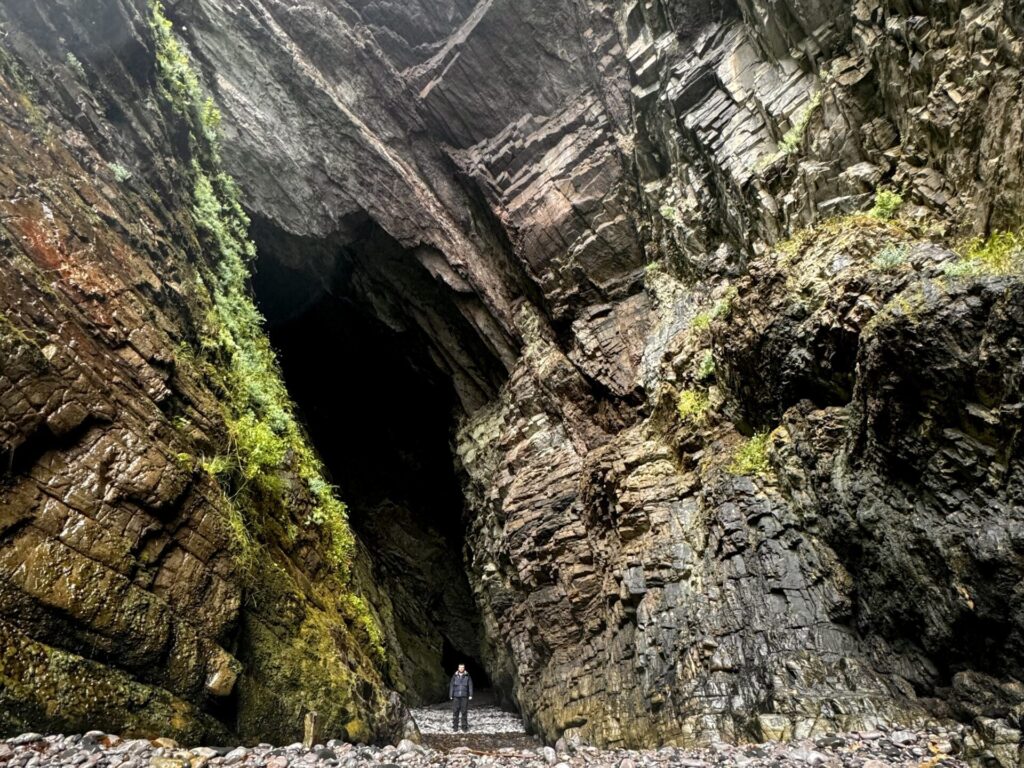
Entrance to MacKinnon’s Cave
Visitors are often surprised to find an award-winning artisan cheese operation in such a remote location. Yet tucked away at Sgriob-Ruadh (pronounced Skreeb-Roo-ah), the Reade family have been farming on Mull for over 50 years and making cheese here for more than four decades.
While the cheese is excellent, Holy cow what really caught me off guard was the café. Known as the Glass Barn, it may well be the most beautiful and relaxing café on Mull. Sunlight filters through an ornamental vine that stretches across the ceiling, creating a living canopy overhead. Surrounded by plants, glass and views across the farm towards the Sound of Mull, it’s the sort of place where lunch somehow turns into a much longer stop than you intended.
The family originally moved north from Somerset in 1963 with a dream of farming in Scotland and supplying milk to Tobermory and the surrounding islands. What began with just ten cows has grown into a herd of around 130 hardy dairy cattle, specially bred to cope with Mull’s wild weather while producing rich, high-protein milk that is ideal for cheesemaking.
Sustainability runs through everything they do. Powered by renewable energy and a healthy dose of island ingenuity, even the whey left over from cheesemaking is put to use, feeding the farm’s pigs or being distilled into spirits. One of them expertly named as Whey-ski. Love it.
You may even be lucky enough to meet founder Chris Reade, who still shares her incredible enthusiasm for the farm and its produce with visitors today. As for my own visit, I can’t claim to have taken the best photographs. I was far too busy working my way through a tremendous ham and cheese toastie and enjoying one of the most peaceful lunch spots on the island.
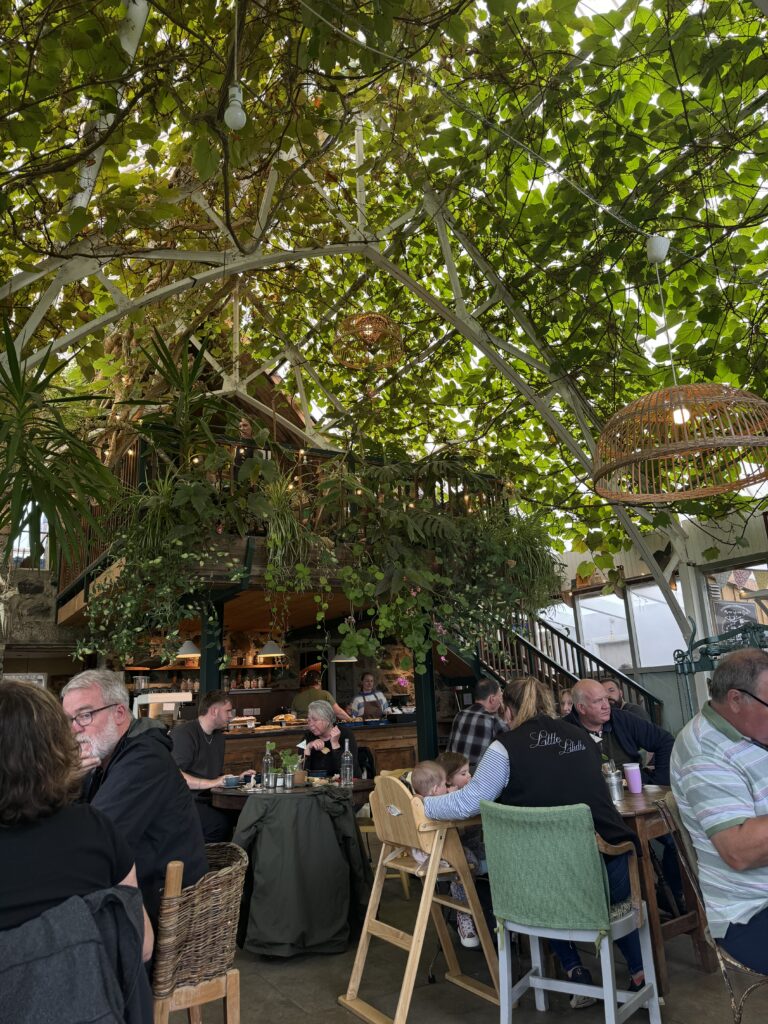
Isle of Mull Glass Barn
Ben More as per its translation is Mull’s big mountain. Literally. It is the only Munro on the island standing at 966m. If you want to climb every inch of the mountain join my wee tradition by whipping off the shoes and having a pre hike dip in Loch Na Keal so when you reach the top you know you have climbed all 966m of the tremendous mountain. Lets not do anything in half measures!
The traditional hike from Dhiseig is a great battle, not particularly long but a testing incline all the way. Thankfully, the 360 degree views do most of the motivating . As you climb, Mull opens up in every direction. On a clear day, you can see right across to Rum, the Treshnish Isles, Jura and the mainland Highlands. On a typical day, you can mostly see mist and your own life choices being questioned. If you want to add a little bit of extra spice to your adventure add in the A’ Chioch ridge. The ridge is airy and requires confidence on exposed scrambling, so only attempt if you are an experienced hillwalker.
The summit itself is properly exposed. No shelter, no nonsense, just a cairn and a lot of air. It is the kind of place where you do not linger too long unless you enjoy being personally attacked by wind. But that is kind of the point. Ben More is not really about comfort. It is about scale. It makes everything else on Mull feel smaller, quieter, and a bit more manageable once you are back down with both feet on level ground and a slightly undeserved sense of achievement.
If you are planning it, take proper gear, check conditions, and do not underestimate how quickly the weather can change up there.
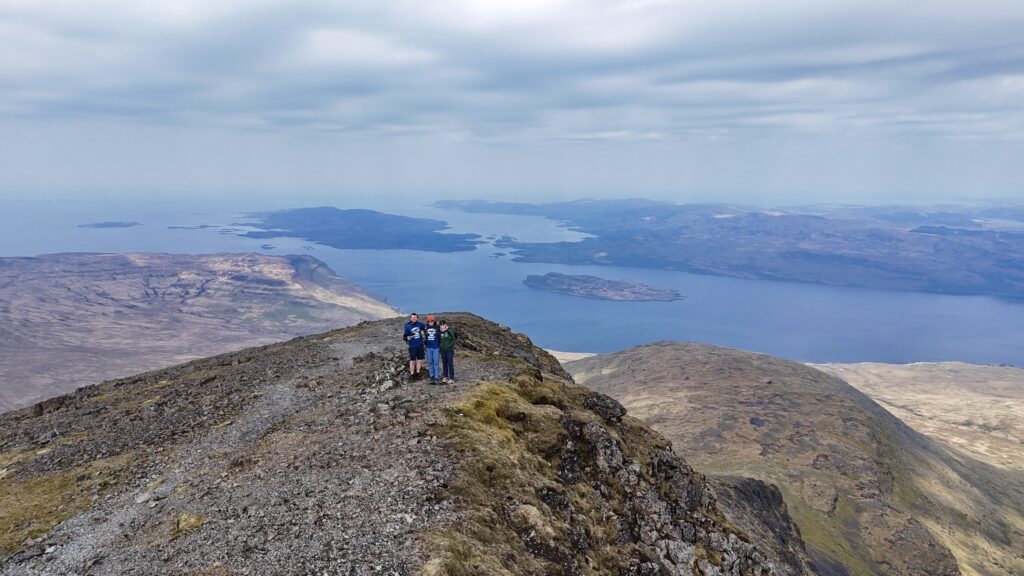
Ben More, Mull’s Highest Peak
Ben More was once one of the largest volcanoes in Britain and when it erupted lava around 60 million years ago it covered the surrounding land including the Ardmeanach peninsula. At this time the landscape was covered with conifer trees and today you take an exhilarating hike 9.5km each way to MacCulloch’s Pectrified Fossil Tree. When I talk about this location I really can’t hide my excitement. It has to be my favourite discovery in Scotland for a long, long time! I have even wrote a whole blog on this hike alone. So if you want to learn more about its geology, the waterfalls, memorials and what else to expect then you can read more here.
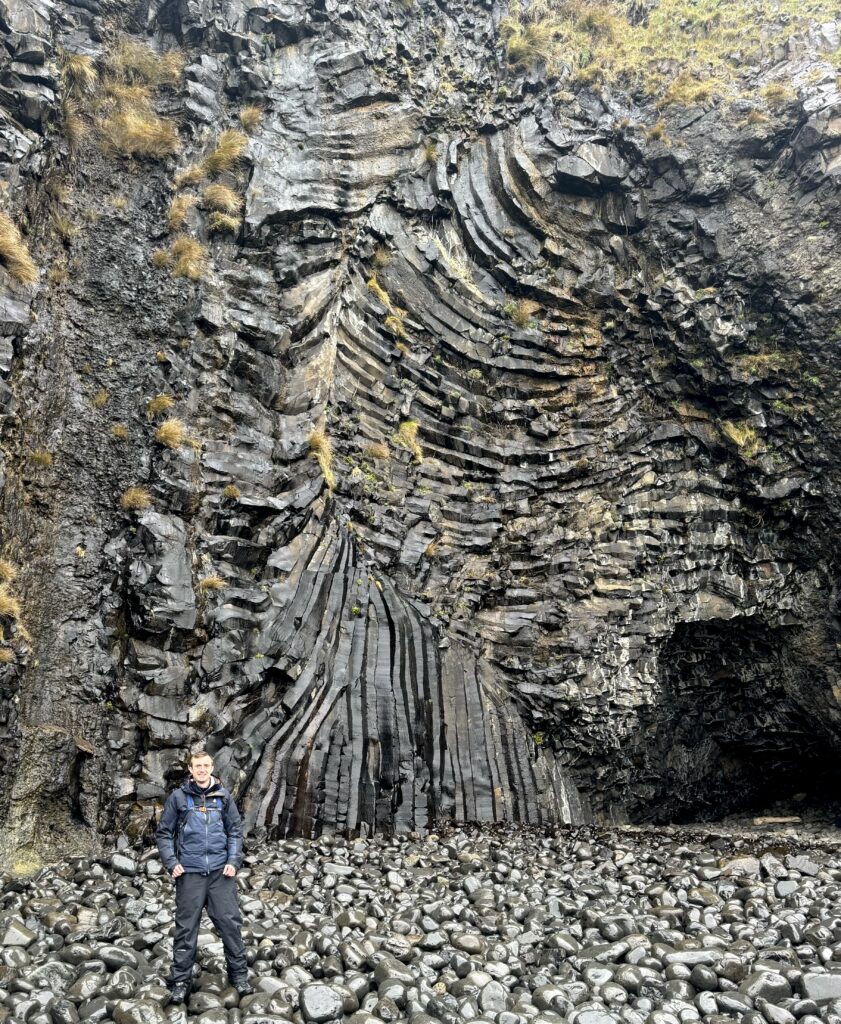
Isle of Mull Fossil Tree
Tucked away on the South Western tip of the Isle of Mull is a wee island that honestly blew my mind, and its not the more famous Iona!
The Isle of Erraid is only accessible at low tide. When the sea pulls back, it reveals one of the most beautiful stretches of white sand that acts as the natural causeway across to the island. If you fancy doing the walk yourself, I’ll drop a Walkhighlands link here.
What makes Erraid even more interesting is that its also famous for another reason. And that’s Robert Louis Stevenson’s classic adventure story Kidnapped. It is here, on the treacherous Torran Rocks just offshore, that young David Balfour is shipwrecked before washing up on what is now often called Balfour Bay.
That was not just fiction pulled out of thin air either. Stevenson had a real connection to the area. He spent time on Erraid visiting his father, who was working nearby on the construction of the lighthouse at Dubh Artach. It was the kind of job that involved battling the sea almost as much as building anything solid on land.
And when you stand there, you understand why he used it as inspiration. Looking across the turquoise water, you also get a view towards the Isle of Iona, a place with a very different kind of energy. This is where St Columba is said to have landed from Ireland in the 6th century, bringing Christianity to Scotland and founding the famous monastery that made Iona one of the most important spiritual sites in the country.
Between them, these islands don’t just sit quietly in the landscape. They feel like they have been part of Scotland’s storytelling for centuries, from saints to shipwrecks to Stevenson’s fictional worlds. It is no surprise he used them as the setting for The Merry Men, where they appear under the name Aros.
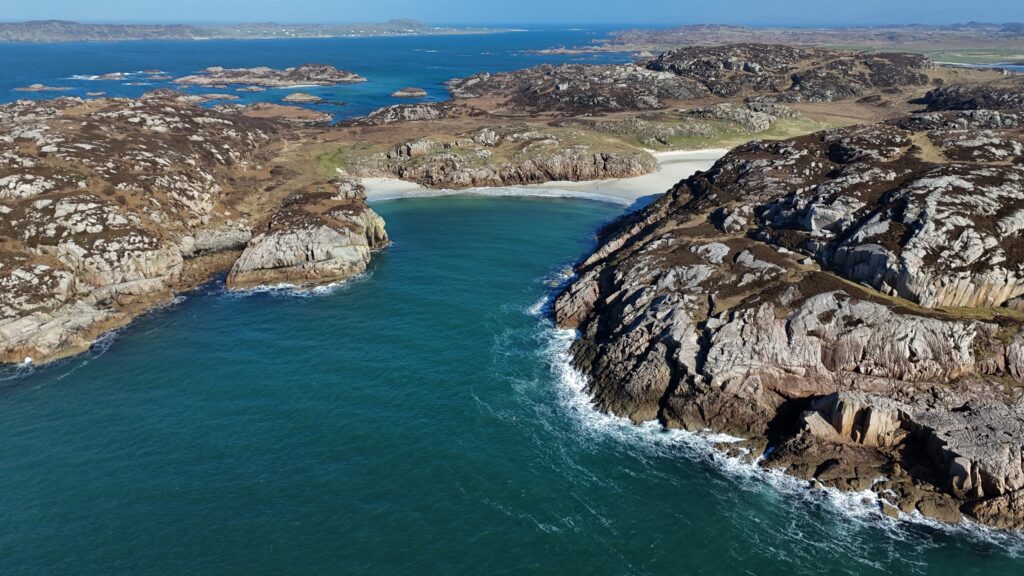
Balfour’s Bay and the Isle of Erraid